
Recovery Support


Access to appropriate and trauma sensitive advocacy and recovery support is critical for victims of child abuse, which is why recovery is one of the four rooms that make up the Bairns Hoose.
Children First Bairns Hoose rights, advocacy and recovery workers coordinate the child’s journey through the Bairns Hoose, from the point of disclosure through to the end of the justice process.
"From early planning, Children First prioritised embedding a safe, caring, authentic relationship at the heart of recovery, and Bairns Hoose, provision." 69
The Bairns Hoose recovery model
The European Barnahus model has evolved primarily to support child victims and witnesses of child sexual abuse and exploitation. As a consequence, Barnahus recovery support is usually described from a perspective that centres specialist, therapeutic, often, psychological based interventions.
In Scotland, Bairns' Hoose is different in that it supports child victims and witnesses of all forms of violence, including physical, emotional, sexual, exploitation and neglect and those who have witnessed and experienced domestic abuse. The wide access criteria for Bairns’ Hoose requires us to think differently about the support and recovery needs of children, young people and families, recognising that they may need an offer of support from a consistent and skilled practitioner that is tailored to them, and informed by their views, needs and their unique experiences.
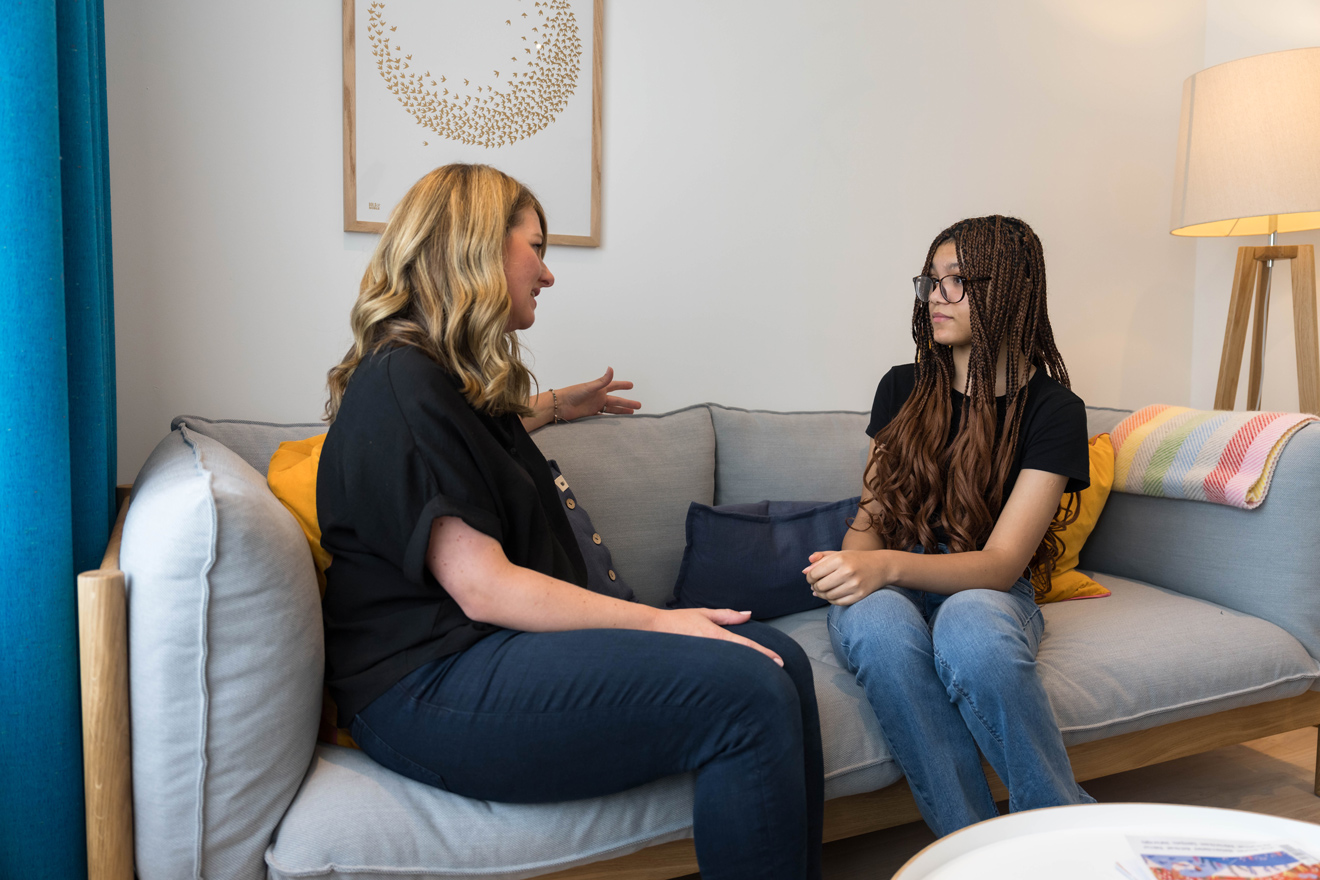
Combining rights, advocacy and trauma
Traditionally in Scotland and prior to the development of Bairns Hoose there was a well evidenced lack of support for children in the aftermath of abuse and violence. Support that combined advocacy and healing through the care, protection and justice systems informed by the participation of the child and their safe family members was extremely rare. The “system” traditionally acts as if the emotional health needs of children and the right for their views to be heard and responded to are distinct. Through our test, learn and develop approach we have designed a model informed by children, caregivers and professionals that recognises the need to integrate all three elements; advocacy, participation and recovery, in one holistic response that moves, flows and develops alongside the changing needs of the child. Children consistently describe feeling disempowered and traumatised by the lack of communication, control or agency within processes and our model is designed to address that deficit.
The Children First Bairns Hoose rights, advocacy and trauma recovery support approach has been informed by the children, young people and families we support and encompasses the range of expressed needs during the development phase of our work to test and learn from this new model. As a result, it is relationship led, holistic and designed be as flexible and adaptable as possible. Our offer of support spans advocacy, practical and therapeutic support and acknowledges the multiple layers of trauma and the intersecting factors that can impact how a child might present and move toward safety and healing. This also acknowledges that that any support offer needs to be mindful and responsive to the wider family and community context and culture.
Children First Recovery model: key values and principles
The University of Edinburgh, Bairns Hoose Phase Two Evaluation Report (2024)
identified key values and principles of the Children First Recovery Model. The authors recognised that:
“Children First’s approach to trauma recovery purposefully defines the model broadly and outside a clinical approach. It aims to offer children and their families a flexible service where support centres and responds to children and families’ individual needs. As such, while it may complement evidence-based clinical interventions, it is not a replacement for such approaches for children who may need them (Lorenc et al., 2020, McTavish et al., 2021).
A challenge associated with this non-manualised approach is communicating the model to others, however there is clear evidence from children, families and professionals that the practice is underpinned by clear and consistent values and approaches." 70
The authors identified these key values and principles as:
- Relationship-based practice: development of consistent trusting relationships at the centre of practice – the means through which young people come to be fully known.
- Child-centred, flexible and responsive: tailoring support to individual needs (how, where, when the child is met and supported and what the focus and approach to the work is) and responsive practice enabled through limited case load size.
- An ecological, systemic approach: committed to recognising and responding to interdependent aspects of children’s lives (families, peer groups, communities and the wider social structures).
- Family inclusive support: acknowledging interdependencies between children’s wellbeing and that of family members.
- Trauma-informed and responsive: able to recognise and respond sensitively to trauma and work to counter re-traumatisation.
- Optimistic and strengths based: recognising children and families as experts in their own lives and maintaining a focus on the future.
- A rights-based approach: promoting children and families right to be part of decision making (participation rights).
- An open-ended support offer: support is not time bound or limited to a set number or type of sessions.
Diagram showing Children First Recovery Model
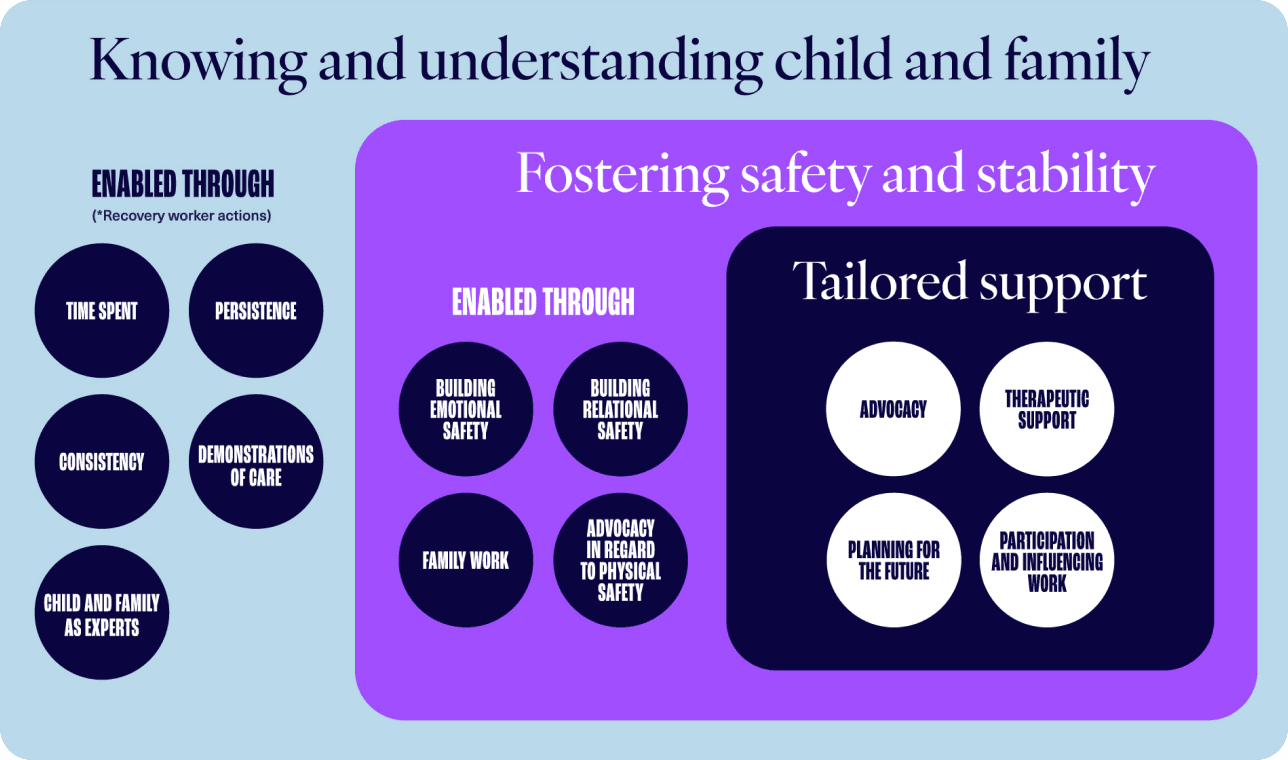
Knowing and understanding child and family:
- Time spent
- Persistence
- Consistency
- Demonstrations of care
- Child and family as experts
Fostering safety and stability:
- Building emotional safety
- Building relational safety
- Family work
- Advocacy in regard to physical safety
Tailored support:
- Advocacy
- Therapeutic support
- Planning for the future
- Participation and influencing work
How the Scottish Child Interview Model supports recovery
The Scottish Child Interview Model aims to support recovery and reduce the impact of trauma and re-traumatisation wherever possible. Interviewers should signpost families to relevant support services where possible and request follow-up support, as a core part of delivery of the Scottish Child Interview Model.
Within the Children First North Strathclyde Bairns Hoose children and their families have access to follow up support as standard. Routine discussions are had with the child, young person and their families about their support needs and where possible they are able to meet support colleagues who can give information about the options for support, minimising bureaucratic referral processes that often serve as either a barrier or delay to support being accessed.
Where appropriate the worker will:
- Meet the child and their family when they arrive for interview and welcome them.
- Advise the child and their parents or carers about data sharing, storage and privacy notice processes and that their details will be held on the Bairns Hoose information management system to enable work with police, social work and others around decision making and to provide coordinated follow up support without them having to repeat their story.
- Inform the child and their family about how they can give feedback about their experience, including space to share their views on the day of interview.
- Seek consent to follow up to discuss support post interview. If consent is given, the family are advised that Children First will liaise with interviewers to obtain the key details of their report, so that Children First can provide support without them having to repeat their story.
- Confirm how best to contact the parent or carer within a few days to answer any questions, offer guidance about what happens next, explore expectations for the next steps and offer support with any immediate issues.
- Offer support around issues not linked to legal processes. For example, support around information being shared on social media, within friendship groups or the wider community that could negatively impact the young person and their return to school. Liaison with parents, carers and school to agree arrangements can be helpful.
The Bairns' Hoose Standards for Scotland
The Bairns’ Hoose standards for Scotland (Health Improvement Scotland/ Care Inspectorate, 2023) have therapeutic recovery support as a core component (Standard 9) of the model and highlight children’s right to access mental health support where needed (Standard 8). There is an emphasis on:
- Timely access to assessment and support.
- Options for short, medium and long term support.
- Tailored and specialised support.
- Access to information and a right to inform decision-making.
- Access to therapeutic support that addresses trauma.
- Support that is inclusive of family and carers.
Standard 9 of the Bairns’ Hoose standards aims to ensure that if children and young people or their family need help, they can speak with someone who understands what they are going through.
"The provision of holistic support to help the child’s recovery from abuse and trauma should be understood by the whole team as a core aim of the Bairns’ Hoose. The Bairns’ Hoose should provide a safe therapeutic environment to continue the ongoing assessment of the child’s needs. It should provide access to evidence-based support services including immediate and follow up support on the day." 71
Provision of recovery support also upholds UNCRC Article 39 requiring the promotion of physical and psychological recovery and social integration of children who have been victims of abuse. Recovery should take place in an environment which supports the health, self-respect and dignity of the child.
The Standards also highlight that support should take into account the child’s wider context, community assets and support needs of the family, including support already in place, to avoid duplication of services and repeated disclosures.
The design of Children First recovery support upholds the Bairns' Hoose standards that state that good relationships and trust between children, families and support workers are critical.
" Children First have refined our therapeutic support for child “victims” and witnesses over twenty five years. Whilst children and young people who come into Bairns Hoose have had some of the most difficult life experiences, we know that within a supportive, kind and caring relationship they and their families can be helped to move forward. "
Children First, Assistant Director
Ways in which Children First provides support to recover
- Children and young people come to the Bairns Hoose having experienced different types of harm. After a warm welcome and introduction to the team, an assessment will be undertaken of their needs, and they will be offered support, advocacy, and recovery as required.
- Children and young people will be offered therapeutic support that addresses the issues that are important to them. For some this includes stabilisation support to help them manage suicidal feelings and self-harm.
- Family members, including siblings, will be offered immediate and longer-term practical, emotional and in some cases, financial support as appropriate.
- Children and families will be offered a key support person through which information, advice, advocacy and support will be delivered as required.
- Support will be offered in the Bairns Hoose itself and at other locations, based on their preference. Timing, frequency, and duration of support is tailored to the child and families wishes and needs.
- We will liaise with other agencies when other more specialist support may be required, e.g. CAMHS.
- Where young people and their families have ongoing contact with other organisations such as ASSIST, Rape Crisis, and Women’s Aid, we ensure that our support is coordinated and avoids duplication or require a young person to repeat their story.
69 Mitchell, M., et. al. (2024) The story so far - North Strathclyde Bairns Hoose Evaluation – Phase two evaluation report. University of Edinburgh. p.41
70 Mitchell, M., et. al. (2024) The story so far - North Strathclyde Bairns Hoose Evaluation – Phase two evaluation report. University of Edinburgh. p.39
71 Health Improvement Scotland & Care Inspectorate (2023) Bairns’ Hoose Final Standards, p.54
72 Mitchell, M., et. al. (2024) The story so far - North Strathclyde Bairns Hoose Evaluation – Phase two evaluation report. University of Edinburgh. p.42
73 Mitchell, M., et. al. (2024) The story so far - North Strathclyde Bairns Hoose Evaluation – Phase two evaluation report. University of Edinburgh. p.15